
Building the Missing Middle
After billions in production investments over the last decade, a new challenge drives the crisis in medical oxygen access. The Oxygen CoLab has a strategy to solve it.

Medical oxygen is a cornerstone of a functional health system. It is an essential medicine required to treat life-threatening conditions like pneumonia and sepsis, to manage complications in childbirth, and to make surgery safe. Yet, for millions of people around the world, it remains out of reach. That’s why the global health community has invested billions to scale up oxygen production over the last decade.
Why, then, does the recent Lancet Global Health Commission on medical oxygen security report that over 60% of the world's population still lacks reliable access?
The oxygen crisis has entered a new, more complex phase. While production capacity has grown, a critical gap is now visible in the middle of the oxygen value chain - between the production facility and the patient’s bedside. The professional management, last-mile logistics, and holistic service delivery needed to bridge this gap are missing. The solution lies in cultivating a thriving ecosystem of local, health-focused businesses to fill this void. It’s time to build the ‘Missing Middle.’
From a production gap to a delivery failure
The global effort to expand oxygen production was a necessary and successful first phase. Governments, donors, and private partners installed publicly-owned PSA plants, mobilised industrial suppliers, and deployed thousands of oxygen concentrators. This is historic progress and should be celebrated, but it hasn't solved the access crisis.
Because production ≠ patient access
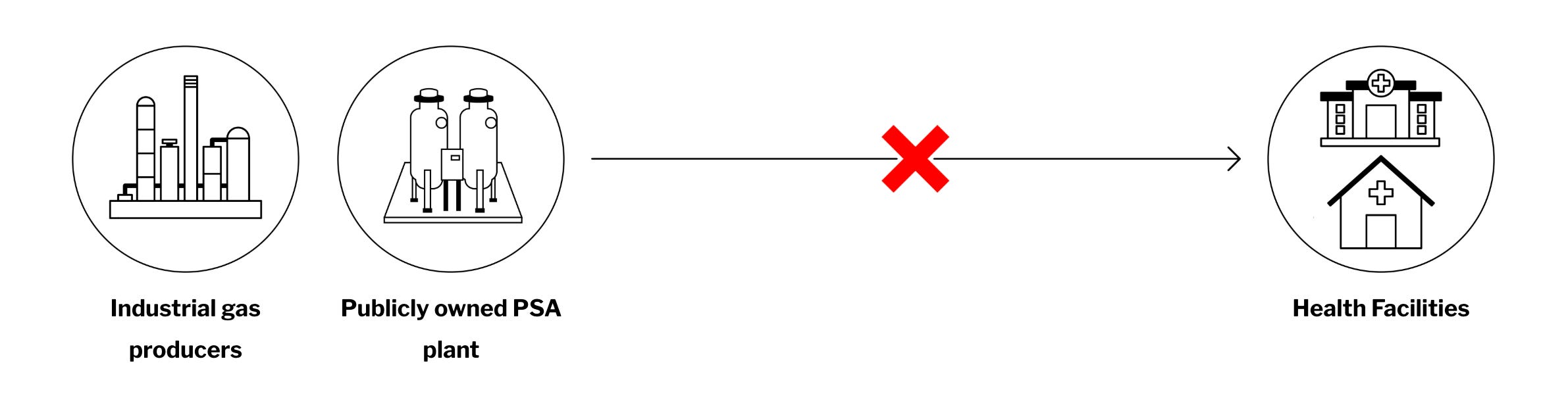
The reality is that whilst more oxygen is being produced, it’s not reaching the people who need it. As the Lancet Commission notes, major investments have “largely focused on the delivery of equipment…but did not invest in the systems and people required to ensure equipment is distributed, maintained, and used safely and effectively.”
This systemic gap is defined by the limitations of the two dominant oxygen sources in the current landscape:
Industrial Gas Producers: These companies are essential for bulk production, but their business models are optimised for large, high-volume industrial clients like mining, energy, and manufacturing, not the unique needs of the health sector. Health facilities are geographically dispersed, require lower individual volumes, and need bundled services like clinical training, diagnostics, and maintenance. For industrial producers, healthcare is often a small fraction of their business, creating a structural misalignment and low incentive to invest in the complex last-mile logistics and wraparound services required to meet health facility needs effectively.
Publicly-Owned PSA Plants: These plants represent significant potential but frequently become underutilised or dormant. They often lack sustainable operational models, including dedicated funding for high running costs, specialised technical capacity for maintenance within government structures, and efficient systems for distributing oxygen beyond the host facility. Without a dedicated, professional operational partner, they become stranded assets.
The 'Missing Middle' of health-focused SMEs
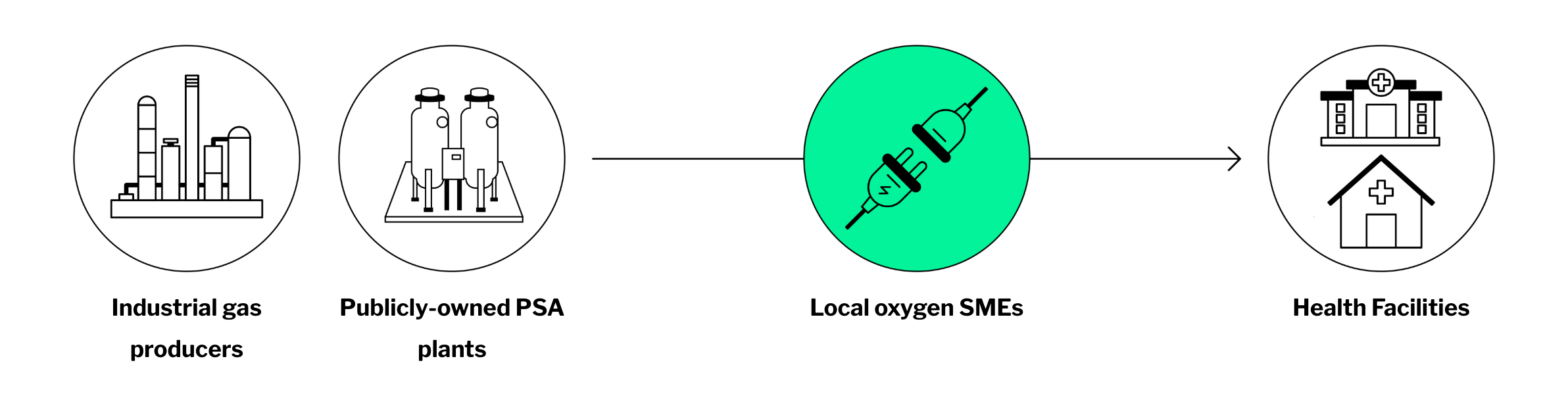
The critical gap is the absence of a robust layer of local Small and Medium Enterprises (SMEs) whose primary focus and core competency is serving the medical oxygen needs of the health sector. These businesses are suppliers, but also market organisers and service integrators.
Their essential functions include:
Aggregating demand from numerous small facilities into viable volumes for large producers.
Professionally operating and maintaining public and private oxygen assets to maximise uptime and quality.
Building and managing the distribution networks required to reach dispersed health facilities.
Delivering holistic, bundled services that health facilities critically need. This includes oxygen supply as well as equipment maintenance, inventory management, clinical training, and consumables etc.
Introducing needed competition and aligning business incentives with patient outcomes (not just production volume).
Investing in these local SMEs is a direct investment in self-reliance. It builds sustainable domestic value chains and local technical capacity, aligning with a broader, essential shift away from aid dependency in global health. Just as local energy entrepreneurs are bringing solar power to remote villages, a thriving ecosystem of oxygen SMEs can bring life-saving care to underserved health facilities.
Proof in practice: A replicable model for transforming access
Over the past five years, the Oxygen CoLab and its partners have shown that building the 'Missing Middle' works. We’ve seen that when local, health-focused businesses are empowered to fill this gap, the results have transformative potential.
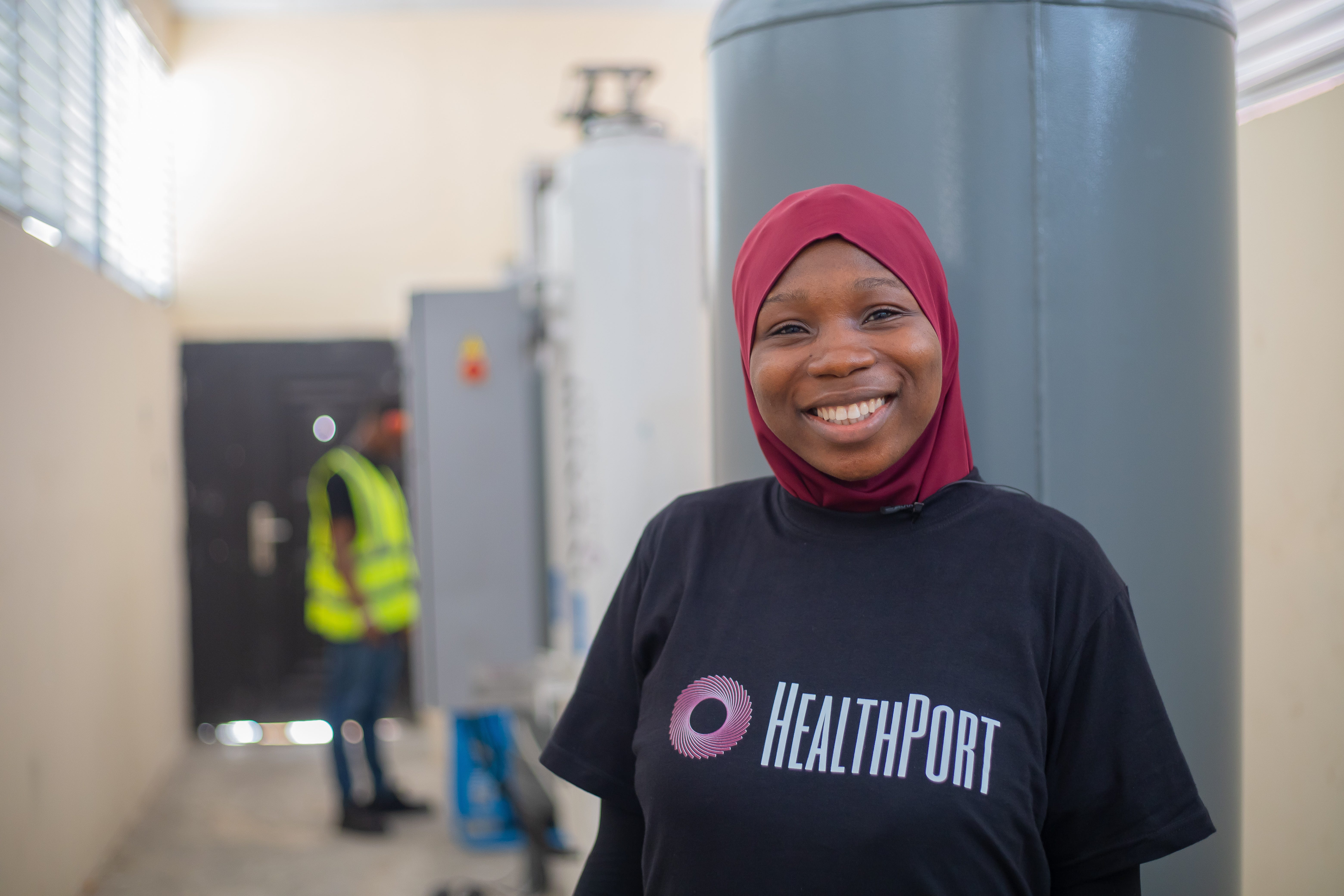
In Nigeria, the local health-tech company HealthPort has demonstrated the power of an integrated service model. Before they began working with their partner hospitals, these facilities could meet only about 10% of their actual oxygen needs. Now, the days of fretting over oxygen scarcity are behind them:
Oxygen is available 100% of the time, even during surge periods.
Clinician confidence has been restored, leading to a 2-3x increase in appropriate oxygen use now that supply is reliable.
The average time to get oxygen to a patient has dropped from 15 minutes to under 1 minute.
In Uganda, the local oxygen social enterprise AFHIA has shown how adaptable this framework is. By cross-subsidising their medical oxygen sales with sales to local light-industrial clients, AFHIA has:
Reduced the price of medical oxygen cylinders by 17% for health facilities.
Dramatically improved supply reliability in their service area in Western Uganda, a region previously dependent on a single, distant supplier.
These examples demonstrate that the 'Missing Middle' is a flexible, powerful framework that can be adapted to different market realities to achieve the same goal: reliable access for every patient. This is about delivering a commodity whilst building a resilient system.
Together, we can build the Missing Middle ecosystem
The lesson is clear. The most catalytic, most sustainable investment we can make in oxygen today is to build the 'Missing Middle'.
At the Oxygen CoLab, we’ve spent five years working toward a rigorous, evidence-based strategy to do just that. Our new approach focuses on driving local market interventions, investing in technology that reduces delivery costs, and building a global coalition of innovators.
But this is a complex challenge, and no single organisation has all the answers. This is our view, grounded in practice, extensive dialogue with our in-country partners, and a wealth of existing academic evidence. We invite you to challenge it, build on it, and share your own expertise, because this challenge needs your voice.
Share this post with your community using the hashtag #TheMissingMiddle, and help us build a richer discussion by tagging the partners, experts, and critics who should be part of it.
To learn more about our work and our coalition partners, visit us at makingbetterfutures.org/aboutoxycolab.
Get in touch at oxygen@makingbetterfutures.org